 Instruo
CRM & sales
- HubSpot
- Salesforce
- Pipedrive
- Zoho CRM
Workflow automation for Australian operational teams
Instruo identifies, prioritises, builds and manages practical workflow automation across the software your business already uses—reducing repeated administration, fragile handoffs and work that disappears between teams.
A$1,500 ex GST diagnostic · Implementation from A$10,000 ex GST · Management from A$1,500 ex GST per month
Your systems, connected deliberately
Instruo assesses how work moves between the systems already in use. A wholesale platform replacement is not the default answer.
Systems commonly assessed—not partnership or compatibility claims. Feasibility depends on the product edition, available API or export path, permissions, data quality, security requirements and vendor terms, and is confirmed during the audit.
The operational problem
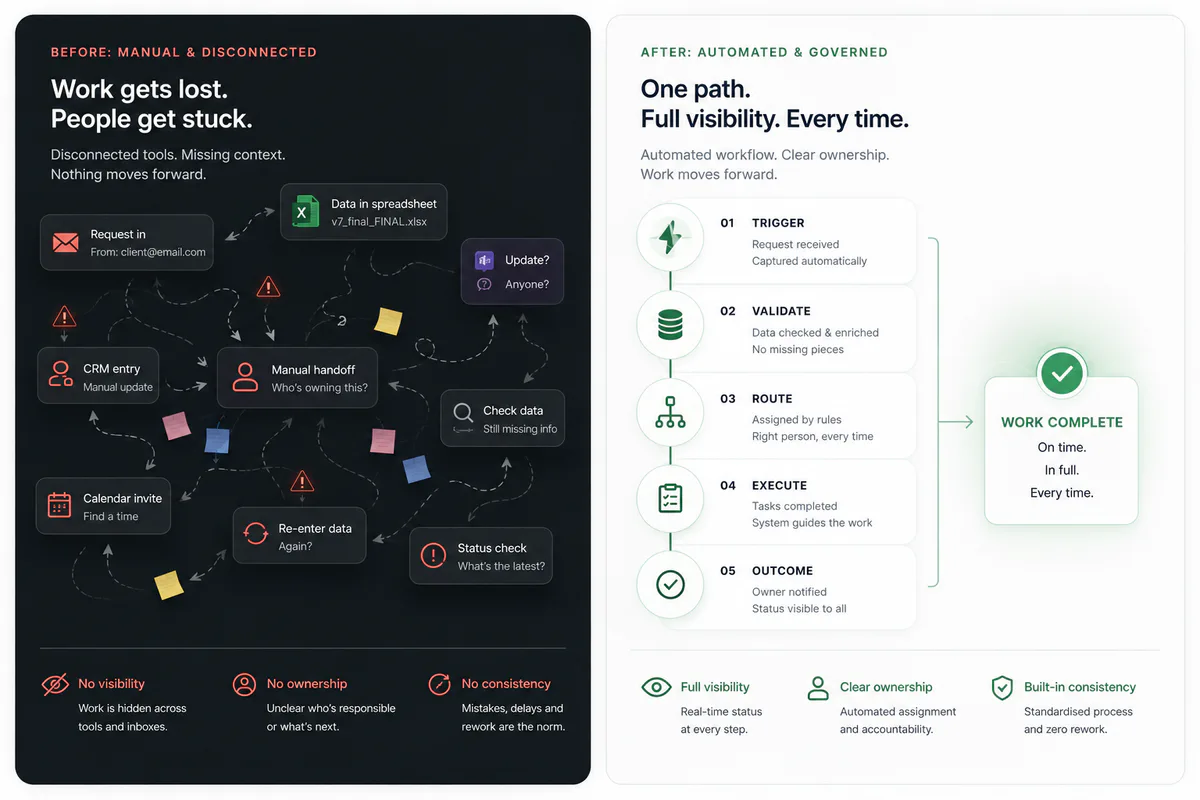
A CRM, inbox, spreadsheet and accounting platform may each work correctly. The burden sits in the gaps: re-keying the same details, chasing an approval, checking whether a document arrived, updating status and rebuilding the report after the fact.
A staff member copies an enquiry from email into the CRM, then enters the same customer or job details elsewhere.
A quote, placement or supplier decision waits in a message thread with no reliable owner or escalation path.
A tracker becomes the unofficial source of truth because operating systems do not show the complete workflow.
Normal work moves, but missing information, duplicates and unusual cases sit outside the process.
Managers reconcile multiple sources before they can see what is late, blocked or ready for action.
The engagement ladder
Start with commercial fit, purchase a bounded diagnostic when justified, implement an approved workflow, then keep it effective as systems and responsibilities change.
Clarify the operational problem, commercial fit and whether a paid diagnostic is justified.
Map the current state, quantify the burden, test constraints and produce a prioritised roadmap.
Design, build, validate and launch the approved workflow with controls, documentation and handover.
Monitor what was implemented, coordinate issues and keep the workflow useful as the business changes.
Timing is indicative and starts once required inputs, access and responsibilities are ready. The audit professional fee is credited to an approved Instruo implementation when the published conditions are satisfied.
Common connection patterns
Dependable automation includes triggers, validation, permissions, approvals, system writes, notifications, logging and a recovery path for exceptions.
Illustrative pattern 01
Exception pathIncomplete or duplicate records go to a named owner.
Illustrative pattern 02
Exception pathCommercial exceptions remain subject to human approval.
Illustrative pattern 03
Exception pathMissing documents enter a visible exception queue.
Illustrative pattern 04
Exception pathSensitive or uncertain messages wait for human judgement.
Indicative delivery timeline
Each stage makes the next commitment clearer. Work can pause when inputs are unavailable and stop when the case, stability or risk does not justify proceeding.
Fit, pain and readiness
Evidence, ROI range and roadmap
Responsibilities and acceptance criteria
Build, controlled testing and launch
Monitoring, support and quarterly review
Approximate planning windows, not universal delivery commitments. Larger or multi-phase implementations may take longer.
Relationship design
A technically sound workflow still needs consistent communication, decisions, ownership and follow-through. Instruo makes that relationship explicit.
Every engagement has a dedicated Client Success Partner as the client’s consistent primary contact. Depending on the approved scope, that person may be the founder or another Instruo delivery lead. Any additional specialist involved is identified before access is granted or delivery begins.
Industry applications
Recruitment agencies are the initial specialist focus. The same coordination problems also appear across other Australian SMEs, without implying experience or regulatory expertise that has not been established.
Initial specialist focus
Workflow patterns to assess
Workflow patterns to assess
Workflow patterns to assess
Delivery principles
The design makes normal work easier without hiding risk, removing accountable judgement or leaving the client dependent on undocumented technical knowledge.
Improve what already works before proposing replacement.
Automate coordination while keeping consequential decisions accountable.
Use limited, revocable permissions and collect only what the workflow requires.
Check inputs, expose failed or unusual work and name the recovery owner.
Record responsibilities, controls, credentials, support paths and change history.
Straight answers
Commercial scope is visible early. Technical certainty follows evidence rather than optimistic assumptions.
The 30-minute Automation Opportunity Call has no charge. The Workflow ROI Diagnostic is A$1,500 ex GST. Implementation starts from A$10,000 ex GST. Ongoing Automation Management starts from A$1,500 ex GST per month.
A responsible decision requires workflow mapping, stakeholder input, burden analysis, system review, opportunity scoring, risk analysis and an implementation roadmap. It is a standalone decision product and remains useful if you do not proceed with Instruo.
That is the starting assumption. Feasibility depends on the actual product edition, access, interfaces, data quality, permissions and vendor constraints. The diagnostic confirms the safe path rather than promising every connection in advance.
A straightforward initial implementation commonly takes about four to eight weeks once scope, access and responsibilities are ready. Larger or multi-phase implementations may take longer.
You provide an accountable process owner, access to relevant staff and systems, timely decisions, test users and final acceptance. Every engagement has a dedicated Client Success Partner as the client’s consistent primary contact. Depending on the approved scope, that person may be the founder or another Instruo delivery lead. Any additional specialist involved is identified before access is granted or delivery begins.
Access is proportionate and least-privilege. Inputs and system responses are validated, exceptions are logged, and human approval remains where judgement or consequence requires it.
Ownership, documentation, credentials, exception handling and recovery responsibilities are made explicit at handover. Ongoing management is available for workflows Instruo has implemented.
No. It is deliberate ownership of implemented workflows: monitoring, issue coordination, minor agreed revisions, operational support and structured quarterly reviews. Third-party licences and usage costs are separate.
Start with the workflow
A 30-minute Automation Opportunity Call is a practical first filter. We will clarify the workflow, its operational effect and whether a paid diagnostic is justified. If the case is weak, we will say so.
No charge. No obligation. Not a free technical audit.